
ASPAR KNOWLEDGE BASE
Shaft and mast freight lifts differ in more than appearance. They are different ways of integrating the platform, guides, guarding and loading points into a building.
The term “cantilever” is used inconsistently in market descriptions and should not be treated as a synonym for every mast system. A technical brief should identify the structural arrangement from the manufacturer's documentation and include a drawing of the required route.
Short answer
A shaft arrangement is considered when the route and guarding are organised within a structural or steel shaft. A mast arrangement uses one or more supporting masts to guide the platform, provided that this layout suits the load, geometry and site conditions.
Neither arrangement is automatically “better”. Selection follows an assessment of the load, travel, platform, loading points and building structure.
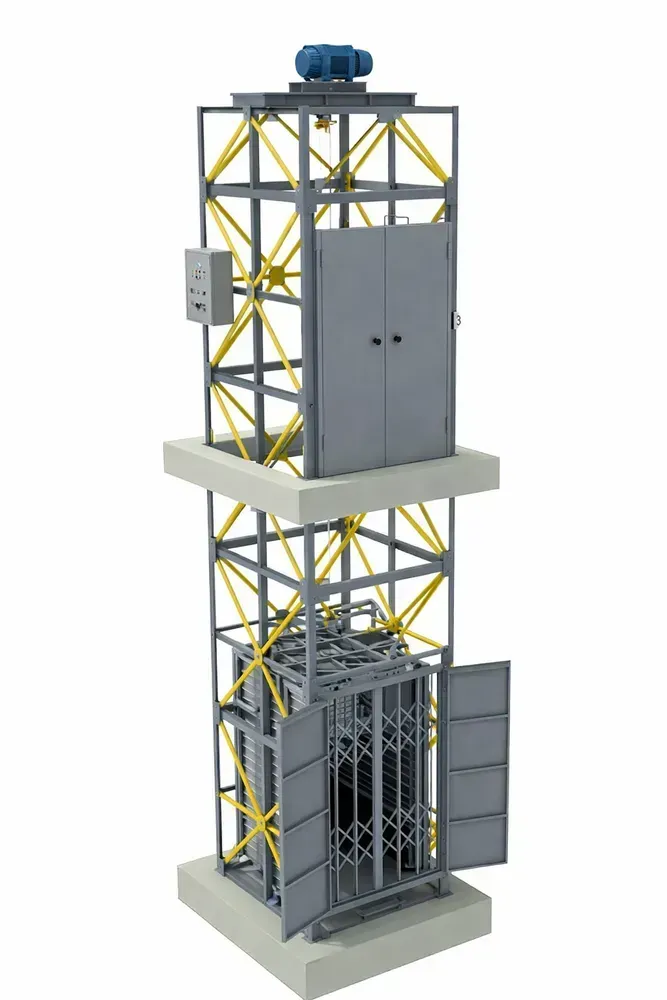
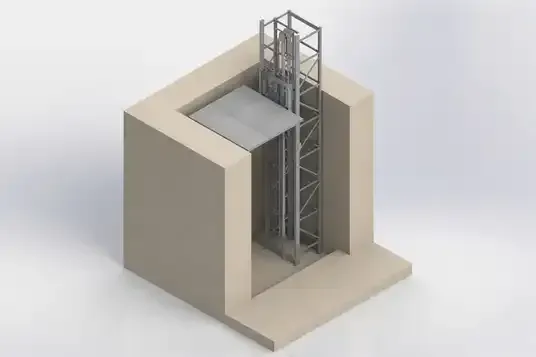
What to compare
| Criterion | Shaft arrangement | Mast arrangement |
|---|---|---|
| Integration | Requires an approved shaft or self-supporting frame | Requires space and a suitable base for the mast and platform |
| Guarding | Provided by the shaft and approved landing doors | Defined by the equipment configuration and movement zone |
| Space | Assess the internal shaft dimensions and openings | Assess the platform, mast and safety-zone dimensions |
| Loading | Door sides may vary with the configuration | The layout depends on the relative positions of the platform and mast |
| Building work | Shaft, openings, pit or other project-specific preparation | Base, fixings, guarding and related project-specific preparation |
The table explains the comparison logic; it is not an equipment specification.
Load and platform
Before choosing an arrangement, define the maximum mass, dimensions, packaging and loading method. Pallets, trolleys, long items and non-standard containers may require different platforms and entry directions.
Do not select from rated load alone. The same numerical capacity does not mean the same dimensions, frame or operating duty.
Supporting structures
The responsible designer assesses the condition of walls, floors, foundations and other building structures. The equipment manufacturer provides load and fixing requirements for the approved configuration, while the building work is checked as part of the project.
The absence of a suitable existing shaft does not automatically mean that a mast lift should be selected. A separate steel frame or another solution may be considered after technical assessment.
Indoor or outdoor installation
An outdoor route requires assessment of precipitation, temperature, wind conditions, drainage, protection of the movement zone and service access. The required equipment execution is determined by the project and equipment documentation.
The marketing label “outdoor lift” does not provide enough information for selection without a description of the structure and operating conditions.
Information required for comparison
- load and process description;
- mass and dimensions;
- number of levels and level data;
- required platform;
- loading directions;
- plan or section;
- site photographs;
- information about an existing shaft or walls;
- indoor or outdoor conditions;
- available power supply.
Useful ASPAR pages
- Products: shaft freight lifts, mast freight lifts
- Knowledge: how to choose a freight lift
- Solution: warehouses and logistics
- Completed freight-lift integration examples: 500 kg external electromechanical lift in Dnipro, 1,000 kg warehouse electromechanical lift in Kyiv
These projects demonstrate different integration conditions; they do not replace selection of the structural arrangement for a new site.
Next step
Send the load description, plan or section, level data and photographs. ASPAR will compare suitable arrangements after reviewing the building conditions.