
ASPAR KNOWLEDGE BASE
Short answer
A lift for stretchers should be selected around the actual transport process in the healthcare facility. Patient weight alone is not enough. The complete scenario includes the stretcher or bed, medical equipment, staff, usable space, direction of travel and loading areas.
This checklist helps collect the project information. It does not establish clinical requirements or replace a site-specific design assessment.
1. Define what will be transported
Document the largest scenario that the equipment must accommodate:
- type of stretcher, bed or trolley;
- dimensions and weight;
- equipment travelling with the patient;
- number of staff members entering the platform;
- staff positions during travel;
- need for through-loading.
Do not determine the rated load from patient weight alone. The final value must account for every component and be checked against the documentation for the selected equipment.
2. Follow the route from door to door
Do not assess only the proposed lift location. Measure corridors, door openings, turns, entrance lobbies, approaches to the platform and the area beyond the exit.
If a stretcher can reach the lift but cannot turn in front of the door or continue at the destination level, the transport task has not been solved.
3. Coordinate the platform and openings
The clear platform dimensions must support the required arrangement of the stretcher and staff. Overall equipment dimensions, the structural opening and the clear door opening are different measurements and must not be treated as interchangeable.
Provide the following for the technical assessment:
- minimum usable platform space;
- entry and exit sides;
- preferred travel direction without complex manoeuvres;
- number of levels and stops;
- actual finished-floor levels.
4. Assess ride quality as part of the process
When moving stretchers, the process should avoid abrupt operator actions, impacts at thresholds and difficult entry. However, no universal speed, “silent” operation or defined ride quality should be promised without documentation for the selected model.
Compare approved configurations by operating scenario, drive type, controls, levelling accuracy, doors and loading arrangement.
5. Check the power supply and stopped-equipment procedure
The project must define the available power supply, connection point and approved procedure in the event of a fault or power failure. Backup operation, manual lowering or any other feature must be verified in the documentation for the specific equipment.
Do not apply the autonomy or operating sequence of another model to a new site.
6. Separate equipment from building preparation
Agree in advance who is responsible for:
- the shaft or steel supporting structure;
- the pit, foundation or supporting base;
- openings and structural reinforcement;
- electrical supply and earthing;
- finishes after installation;
- service access to the equipment.
The scope depends on the configuration. There is no universal builder's-work package for every hospital lift.
7. Information required for a quotation
- type and dimensions of the largest stretcher or bed;
- total design load for the complete scenario;
- number of levels and travel height;
- route plan;
- door, corridor and landing dimensions;
- photographs of the installation area;
- loading directions;
- available power supply;
- indoor or outdoor location;
- restrictions on building work.
Choosing a stretcher-route architecture
For a stretcher route, ASPAR first determines the construction and travel path, then agrees the project-specific configuration. Scissor, vertical and hoistway solutions are not interchangeable: each matches a different route architecture.
| ASPAR solution | Construction and drive | Verified characteristics | When to consider it |
|---|---|---|---|
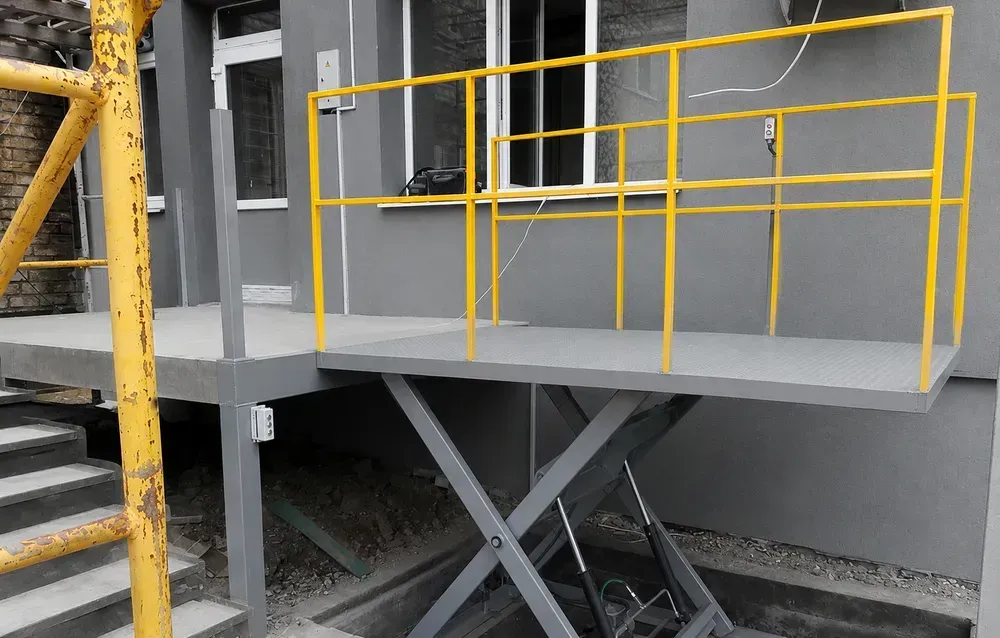
| HMS — scissor lift for hospital stretchers | Scissor platform, hydraulic drive | Load capacity 1000–2000 kg; travel up to 2 m | When the route has a level difference of up to 2 m and a scissor construction suits the site conditions. |
| HMV — vertical hospital stretcher lift | Vertical mast-type construction, chain/electric drive | Load capacity 1000–2000 kg; travel up to 4 m | For vertical movement of stretchers, beds or equipment between levels. |
| HMH — hoistway hospital stretcher lift | Inter-floor hoistway construction, hydraulic/electric drive | Load capacity 1000–2000 kg; travel up to 24 m; up to 8 stops | When the route is arranged in a hoistway and access is needed between multiple levels. |
The table defines model scope, not a ready-made solution for every hospital. Final selection depends on the complete project brief.
What determines the choice
Selection requires platform dimensions, the complete design load, travel height, number of levels and stops, route geometry, entry directions, space around the doors, hoistway or installation-area parameters and building-work conditions. ASPAR determines the configuration from this complete set of project data.
Common questions
When should an HMS scissor lift be considered?
HMS can be considered when the route difference matches the model’s travel of up to 2 m and a scissor construction suits the site. Dimensions, load, route and installation conditions are then checked together.
When is an HMH hoistway lift considered?
HMH can be considered for a hoistway route with access between multiple levels. Stops, hoistway parameters, entry arrangement and medical-transport dimensions are coordinated for the project.
Compare hospital lifts for stretchers, review hospital solutions and send the project information for engineering selection.
Useful ASPAR pages
- Product: hospital lifts for stretchers
- Solution: hospitals
- Related completed project in a healthcare facility: vertical platform lift for a medical laboratory in Kryvyi Rih
- Related completed project at a rehabilitation facility: hydraulic platform lift at a rehabilitation centre in Irpin
These projects demonstrate ASPAR's work in healthcare and rehabilitation settings; they are not presented as stretcher-transport projects.
Next step
Send the dimensions of the largest stretcher or bed, the route plan, photographs and all known level data. ASPAR will check whether the information is complete before selecting a configuration.